
Product & Industry Guide
FDA Detention Testing for Spices & Seasonings
Imported spices are frequently detained for Salmonella, illegal dyes, filth, and mycotoxins. Here's why FDA holds spice shipments, which import alerts apply, and what sampling and testing typically involve.
The Short Version
Why Spice Shipments Get Detained
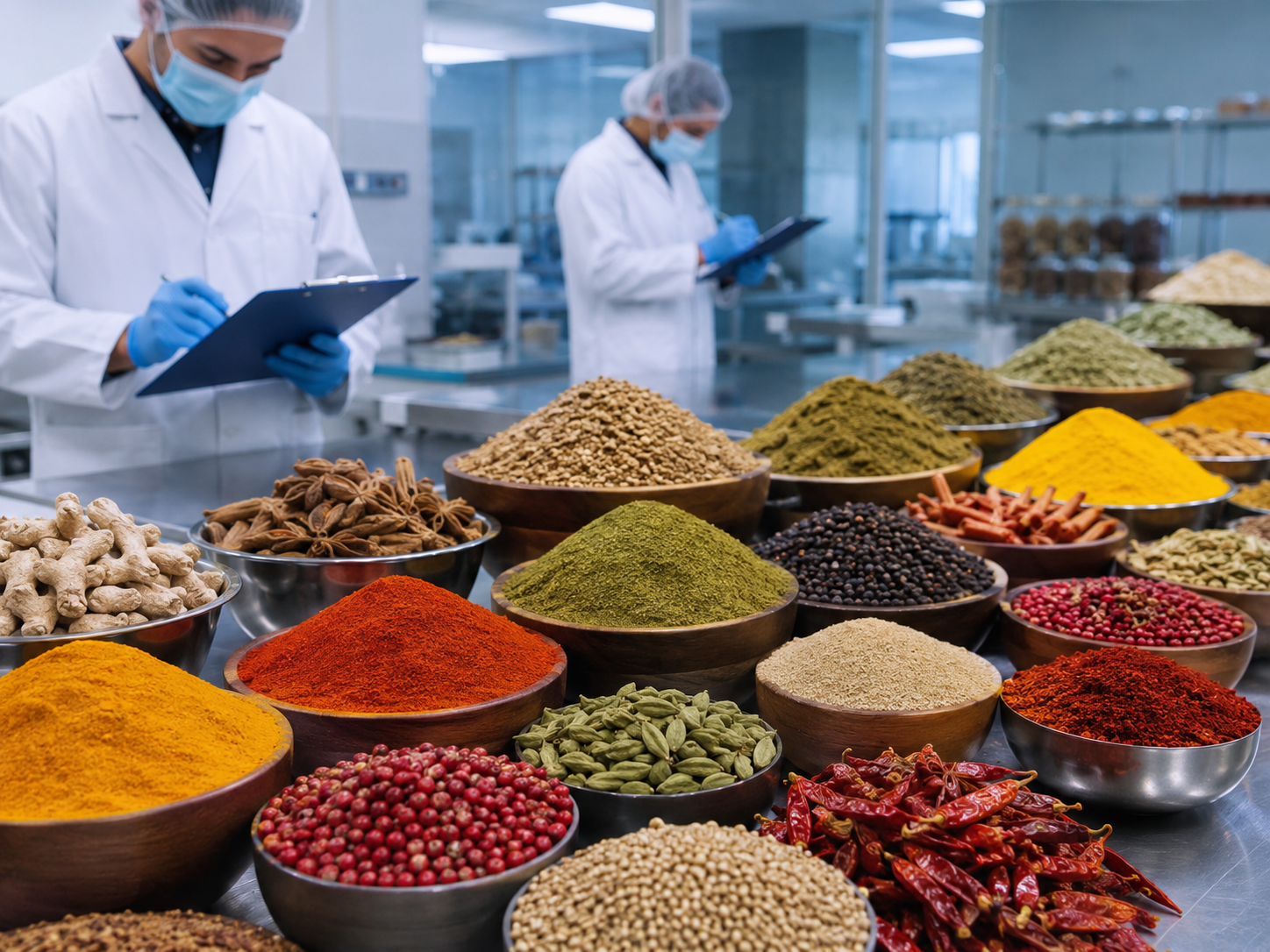
Spices and seasonings are among the most Salmonella-detained foods, and they also face illegal-color and filth charges. Because spices are often grown, dried, and handled in open-air conditions, contamination with Salmonella or filth is common, and some suppliers illegally add unapproved dyes — like Sudan colors in chili and paprika — to enhance appearance. Certain spices also carry mycotoxin risk. Each charge demands a different test, so identifying exactly what FDA cited is the first step.
The Alerts That Apply
Import Alerts That Commonly Hit Spices
These are among the most frequent spice detentions. Select any alert for a full plain-language guide:
Food Products — Salmonella
The catch-all Salmonella alert that captures many spices and seasonings not covered elsewhere.
Read the guide IA 45-02Illegal / Undeclared Colors
Unapproved dyes like Sudan colors in chili, paprika, and spice blends — an adulteration charge.
Read the guide IA 23-14Food Products — Mycotoxins
Aflatoxins and other mycotoxins that can affect certain dried spices and seasoning ingredients.
Read the guideThe Common Charges
What Spices Get Charged For
- Salmonella
- The leading spice detention. A zero-tolerance pathogen charge — presence in a representative sample renders the spice adulterated.
- Illegal Dyes
- Non-permitted colors such as Sudan I-IV, para red, or Rhodamine B added to chili, paprika, turmeric, or curry blends to boost color — an adulteration charge that relabeling cannot fix.
- Filth
- Insect fragments, rodent hair, or other filth detected on inspection — common in bulk, open-dried spices.
- Mycotoxins
- Aflatoxins and ochratoxin in certain spices (e.g., chili, nutmeg, paprika), tied to storage and humidity.
- Undeclared Colors
- Even a permitted color not declared on the label is a misbranding charge — sometimes correctable, unlike a non-permitted dye.
- Heavy Metals
- Lead and other metals appear in some spices, occasionally from adulteration or environmental sources.
The Testing
What Spice Testing Involves
-
Representative Sampling
A trained sampler collects representative sub-samples across the lot under documented custody — important for spices, where contamination like Salmonella or aflatoxin is often unevenly distributed.
-
Analyte-Matched Analysis
The charge dictates the method: microbiological culture for Salmonella, chromatographic dye analysis for illegal colors, LC-MS/MS or ELISA for mycotoxins, at an appropriately accredited (often LAAF) lab.
-
Package & Submit
Results, methods, and custody records are assembled into an analytical package and submitted to FDA, typically via ITACS, for review. FDA makes the final admissibility decision.
Uneven contamination makes sampling design critical. With spices, where you sample matters as much as how you test. See how sampling is documented in our chain of custody guide.
Be Realistic
Honest Notes on Spice Detentions
Set expectations honestly
- An illegal dye can't be declared away. If a non-permitted color like a Sudan dye is present, the spice is adulterated regardless of labeling — testing confirms rather than clears it.
- Zero-tolerance means zero. For Salmonella, a positive in a representative sample is disqualifying; testing shows a clean sample but can't remove a pathogen that's present.
- Sampling design can make or break the case. Uneven contamination means a poorly designed sample can produce a misleading result and a rejected package.
- Release isn't removal. Clearing one spice shipment doesn't lift an alert on the firm or country; that's a separate removal petition.
- No guaranteed outcome. We coordinate defensible sampling and testing to give your evidence its best footing — but FDA decides admissibility.
Related
Related Guides
Private Laboratory Testing
How the analytical package that supports a spice release is built and submitted.
Read the guide HubAll Products & Industries
Browse detention testing guides for every product category we cover.
Browse categories HelpDetention Help Center
Notice, timeline, testing, cost, and removal — the full detention playbook.
Get helpSpices Detained?
Send the Notice — We'll Match the Right Test
Send your Notice of FDA Action and the spice or blend involved. You'll get a quick, honest read on whether the charge points to Salmonella, an illegal dye, mycotoxins, or filth — and what testing can do.
Urgent detention matters receive priority intake review.
FDA Detention Sampling is an independent private company. We are not affiliated with, endorsed by, or part of the U.S. Food and Drug Administration. This guide is general information about FDA import detention and testing for spices and seasonings; the charge and instructions on your specific Notice of FDA Action, and the applicable import alert, control. Sampling, laboratory testing, documentation, and coordination services do not guarantee FDA release, admissibility, acceptance of laboratory results, removal from any import alert, or any specific regulatory outcome. FDA makes the final admissibility decision.